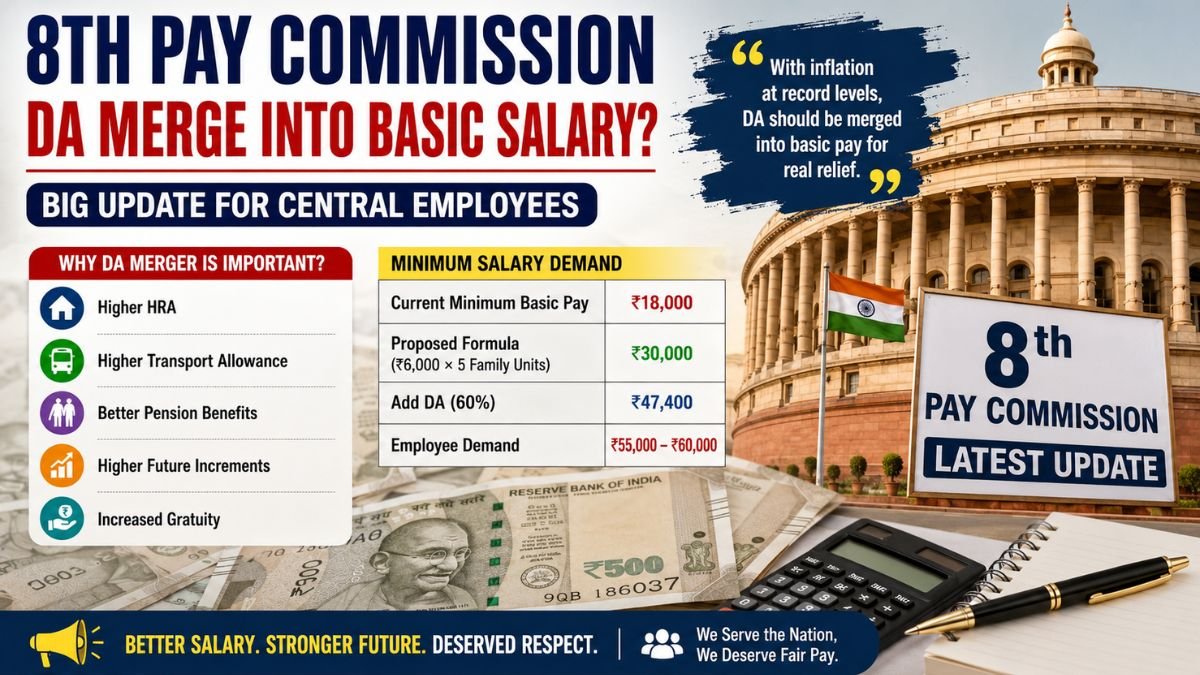
For millions of central government employees, one question is creating a lot of hope right now — will Dearness Allowance (DA) finally merge into the basic salary under the 8th Pay Commission? da merger 8th pay commission
Over the last few years, daily expenses have quietly become heavier. Grocery bills feel bigger. School fees keep rising. Rent, medical costs, electricity bills — everything seems more expensive than before. Even families with stable government jobs are feeling the pressure.
That’s why employee unions are now strongly demanding that the government merge DA with basic pay, instead of keeping it as a separate allowance.
Why Are Employees Demanding DA Merger in the 8th Pay Commission?
Right now, Dearness Allowance is paid separately to central government employees. It’s mainly meant to help people deal with inflation.
DA has increased so much over the years that employees believe it should no longer stay separate from the salary structure. According to employee organizations, once DA becomes part of the basic salary, many other financial benefits automatically increase too.
That includes:
| Salary Component | Possible Impact |
|---|---|
| House Rent Allowance (HRA) | Could increase |
| Transport Allowance | Higher benefits possible |
| Pension | Better retirement benefits |
| Annual Increment | Bigger future hikes |
| Gratuity | Higher payout |
DA Reaching Nearly 58% Has Increased Expectations
According to a memorandum submitted by the All India NPS Employees Federation to the 8th Pay Commission, Dearness Allowance was expected to reach nearly 58% by December 2025.
That number says a lot.
It reflects how expensive everyday life has become for ordinary families.
Many middle-class employees now feel that salary growth hasn’t matched the real increase in living costs. One central employee recently wrote online:
That emotional frustration is exactly why this issue has become so important for government staff across India.
What Does DA Merger Actually Mean for Employees?
A lot of people hear this news and wonder, “Okay… but what changes for me?”
The answer is simple.
When DA merges into the basic salary, the “base” used to calculate other benefits becomes bigger. Since many allowances are linked directly to basic pay, employees could see a much stronger overall salary package.
For example:
- Future salary increments may become larger
- Retirement benefits may improve
- Pension calculations could become more favorable
- HRA may rise significantly in some cities
For families already struggling with rising expenses, even a moderate increase can make a real difference.
8th Pay Commission Minimum Salary Demand Explained
Another major demand is related to the minimum basic salary.
Under the 7th Pay Commission, the current minimum basic pay is ₹18,000. But employee unions argue that this amount was based on old assumptions and outdated family expense models.
According to the federation, the old salary structure considered a 3-member family unit, while today’s economic reality is very different.
That’s why unions are now demanding calculations based on a 5-member family model.
Proposed Salary Calculation
| Proposed Formula | Estimated Amount |
|---|---|
| ₹6,000 × 5 family units | ₹30,000 |
| Adding current DA (60%) | Around ₹47,400 |
Based on rising food costs, healthcare expenses, education fees, and inflation, employee organizations believe the new minimum salary should ideally fall between ₹55,000 and ₹60,000.
For many workers, this isn’t about luxury.
It’s about financial survival with dignity.
Can the Government Really Merge DA Into Basic Pay?
At the moment, there’s no official confirmation from the government.
But historically, DA has been merged with basic pay in previous pay commissions when inflation levels became too high. Since DA has now reached very high levels again, discussions around another merger are becoming stronger.
If the proposal is accepted under the 8th Pay Commission, it could benefit:
- Central government employees
- Pensioners
- Future recruits
- Families dependent on fixed salaries
And emotionally, it may also bring something many people desperately want right now — a little financial breathing space.
What Central Government Employees Are Hoping For
Most employees today aren’t asking for unrealistic luxuries.
They simply want salaries that match modern living costs.
A central government worker from Gujarat recently shared:
That feeling is becoming more common across India.
People are waiting for the 8th Pay Commission not just as a salary revision… but as a chance to regain financial balance.
8th Pay Commission Latest Update: Key Highlights
Important Points So Far
- Employee unions have started discussions with the Pay Commission
- Strong demand raised for DA merger into basic salary
- Minimum salary revision is under discussion
- A 5-member family model has been proposed
- Minimum salary demand ranges from ₹55,000 to ₹60,000
FAQs About 8th Pay Commission and DA Merger
Will DA definitely merge into basic salary?
Not officially yet. However, employee unions are strongly pushing for it during discussions related to the 8th Pay Commission.
Why is DA merger considered important?
Because many salary benefits like HRA, pension, and increments depend on basic salary calculations.
How much DA has increased recently?
According to employee federation estimates, DA could reach nearly 58% by the end of 2025.
What could be the new minimum salary under the 8th Pay Commission?
Some employee organizations are demanding a minimum salary between ₹55,000 and ₹60,000.