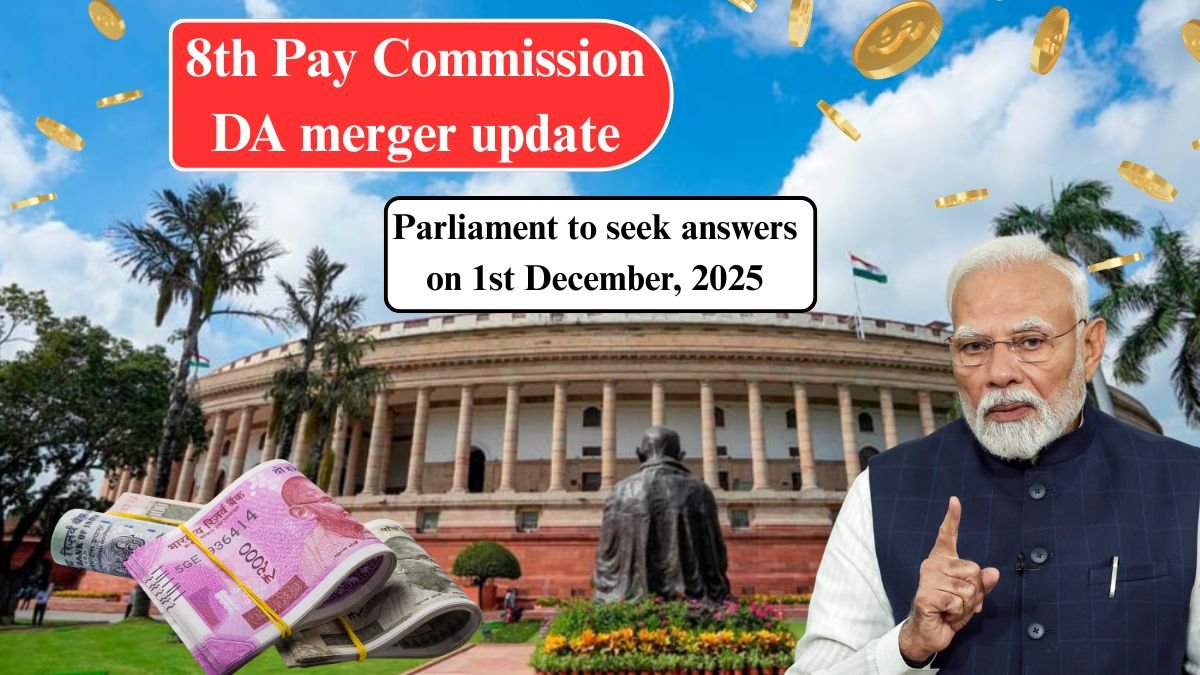
Here’s the thing—every time a new Pay Commission comes close, Central employees start hoping for some relief. And honestly, with prices climbing the way they have in the last two years, who wouldn’t? The 8th Pay Commission (8th CPC) has been making noise for weeks, but the big moment came when the government finally spoke about it on the very first day of the Winter Session. 8th Pay Commission DA merger update
What Exactly Did the Government Say About the 8th Pay Commission?
The government confirmed what everyone wanted to hear:
the 8th CPC has been officially constituted through a Gazette notification issued on 3 November 2025.
The three-member panel includes:
- Justice Ranjan Prakash Desai – Chairperson
- Prof. Pulak Ghosh – Part-time Member
- Pankaj Jain – Member-Secretary
But here’s where things get tricky.
When asked whether DA would be merged with Basic Pay—something many employee groups were counting on—the government’s reply was blunt: “No such proposal exists.”
So the current system stays the same:
- DA/DR revisions every six months
- Calculations based on AICPI-IW index
This one line was enough to disappoint a large section of employees and pensioners who were hoping for some immediate relief.
Why So Much Frustration Among Employees and Pensioners?
Think about it. When the Terms of Reference (ToR) came out earlier this month, everyone rushed to find out what’s included. And that’s where the disappointment started.
Here’s why the concerns are piling up: Parliament to Seek Answers on 8th Pay Commission and DA Merger on December 1
1. Pensioners are not explicitly mentioned this time
In the 7th Pay Commission, pensioners had a clear place in the ToR.
This time? Silence.
Many believe this weakens the scope of pension revision.
2. No clarity on when the new pay structure will kick in
Will the new pay matrix apply from 1 January 2026, like earlier commissions?
Or will it be implemented later?
The ToR doesn’t say a word.
3. Several core demands excluded
As per Staff Side (JCM), these important points didn’t make the cut:
- Formula for calculating minimum wage
- Fix for pay compression
- Framework for regular wage revision
Unions argue the language used in this ToR feels more restricted than what was used in the 7th CPC.
So What Happens Now?
The 8th CPC has an 18-month working period. That means months of:
- Collecting data
- Meeting departments
- Listening to union representations
- Studying the impact of inflation and wage growth
Meanwhile, employee groups are already gearing up for a louder fight.
And honestly, it’s understandable—when cost of living keeps rising and DA merger is dismissed upfront, tension naturally increases.
The big year is 2026, when Pay Commission recommendations are usually implemented. So yes, the debate around the 8th Pay Commission is only going to heat up in the coming months.
Quick Comparison: What Employees Expected vs What Actually Happened
| What Employees Hoped For | What the Government Said |
|---|---|
| Formal notification of 8th CPC | ✔ Confirmed |
| DA to be merged with Basic Pay | ✘ No proposal |
| Pensioners included clearly | ✘ Not mentioned in ToR |
| Clarity on new pay structure date | ✘ No timeline |
| Wider ToR language like 7th CPC | ✘ More limited |